
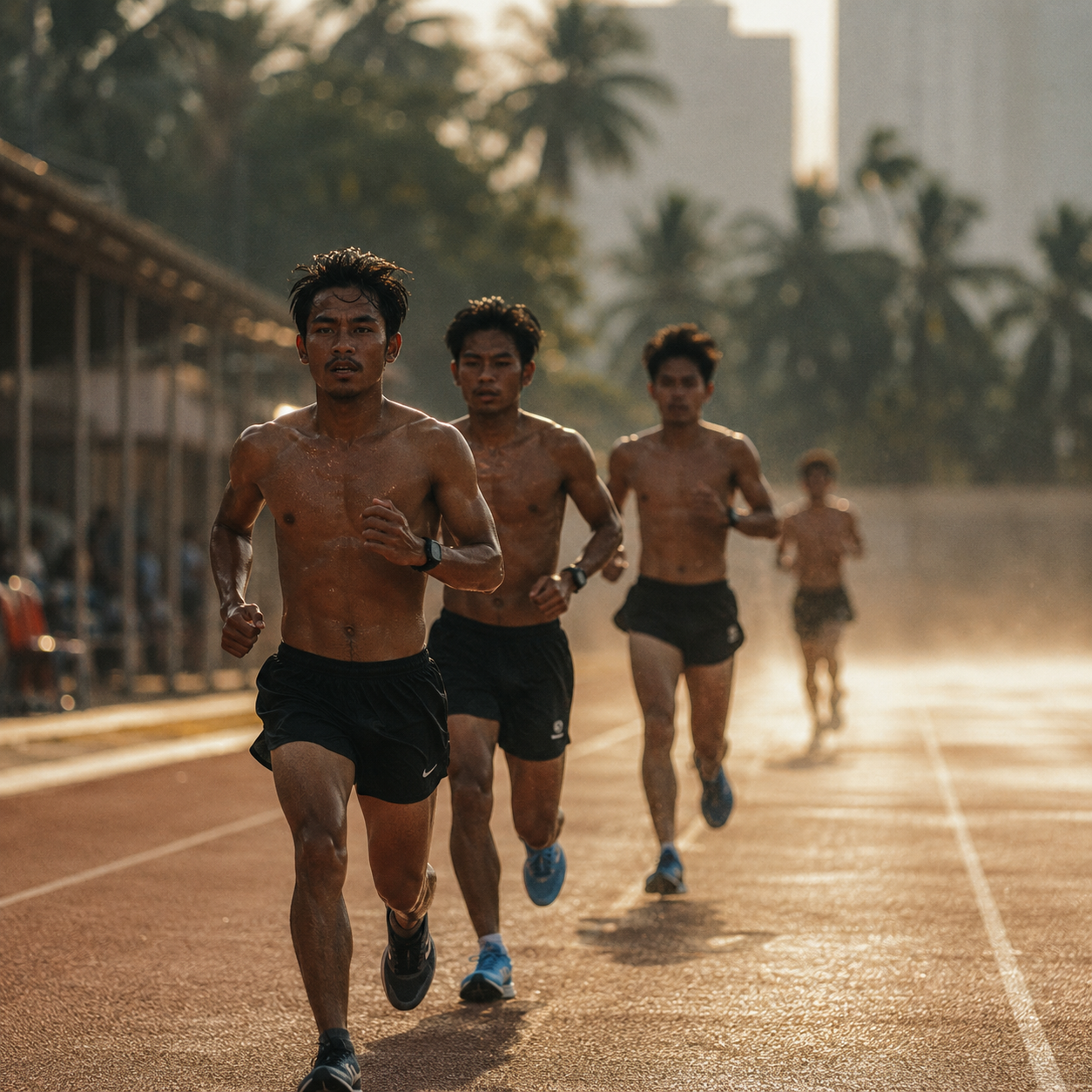
There is a paradox at the heart of Malaysian sports science that researchers at Universiti Malaya have spent years trying to resolve. Malaysian athletes train in one of the most thermally challenging environments in the world — daily temperatures of 32 to 36 degrees Celsius, humidity above 80 percent — and yet this is treated as a problem to be managed rather than an adaptation to be leveraged.
The research coming out of UM’s sports science faculty is beginning to suggest that the conventional wisdom needs revision.
What the Research Shows
According to sports science research published through Universiti Malaya’s Faculty of Sport and Exercise Science, Malaysian athletes who train consistently in high-heat conditions develop measurable thermoregulatory adaptations — improved plasma volume, earlier sweat onset, reduced cardiovascular strain at a given exercise intensity in the heat — that athletes from temperate climates do not have at baseline.
This is not a new finding in sports science globally. What the Malaysian research has been doing is quantifying the specific adaptation profiles of Malaysian athletes across disciplines, and examining whether current training practices are optimising for those adaptations or inadvertently undermining them.
The preliminary finding — and these are ongoing research programmes, not concluded studies — is that Malaysian sports preparation has historically undervalued the heat acclimatisation advantage and sometimes actively trained it away by using air-conditioned facilities as the default training environment.
The Air-Conditioning Problem
Modern Malaysian sports facilities are air-conditioned. This is entirely reasonable from a comfort and health standpoint. But it means that athletes who spend most of their training time in 22-degree controlled environments are losing some of the heat adaptation that their climate would otherwise provide.
For athletes preparing for international competitions in hot conditions — Southeast Asian Games in tropical venues, competitions in the Middle East, outdoor events in humid coastal cities — this represents a genuine performance consideration. The Paris 2024 preparation cycle included deliberate heat exposure blocks for this reason.
For athletes preparing for competitions in temperate climates — European venues, East Asian indoor competitions — the picture is different. But those competitions are also where Malaysia’s medal opportunities often concentrate.
The Practical Application
The UM research has influenced how some Malaysian national programmes structure their training environments. Rather than defaulting entirely to air-conditioned facilities, coaches in disciplines including athletics and cycling have begun incorporating deliberate outdoor training sessions at specific points in the periodisation cycle.
This is not about making athletes suffer unnecessarily in the heat. It is about using Malaysia’s environmental conditions strategically — recognising that training in 34 degrees in Petaling Jaya produces physiological adaptations that are difficult to replicate in a climate-controlled facility, and that those adaptations have competitive value.
The sports health reckoning after the MCO lockdown period was partly about what detraining in indoor environments did to Malaysian athletes’ baseline conditioning. The heat research extends that conversation: what does systematic climate management do to the specific adaptations that Malaysian athletes’ bodies can develop?
The Broader Implication
The most interesting implication of the UM research is not for elite Olympic preparation — it is for grassroots development. If heat adaptation is a genuine physiological advantage, then Malaysian youth athletes who train outdoors in their natural environment are building something that their international competitors have to work harder to acquire.
This is not an argument against sports facilities. It is an argument for understanding what the Malaysian climate provides and building training models that use it intelligently rather than uniformly treating it as an obstacle.
The sports scientists at UM are doing the work of making that case with data rather than intuition. The question is how quickly Malaysian sports administration translates the research into programme design.
It rarely happens as fast as the researchers would like. But the research is now there to draw on, which is more than could be said five years ago.