
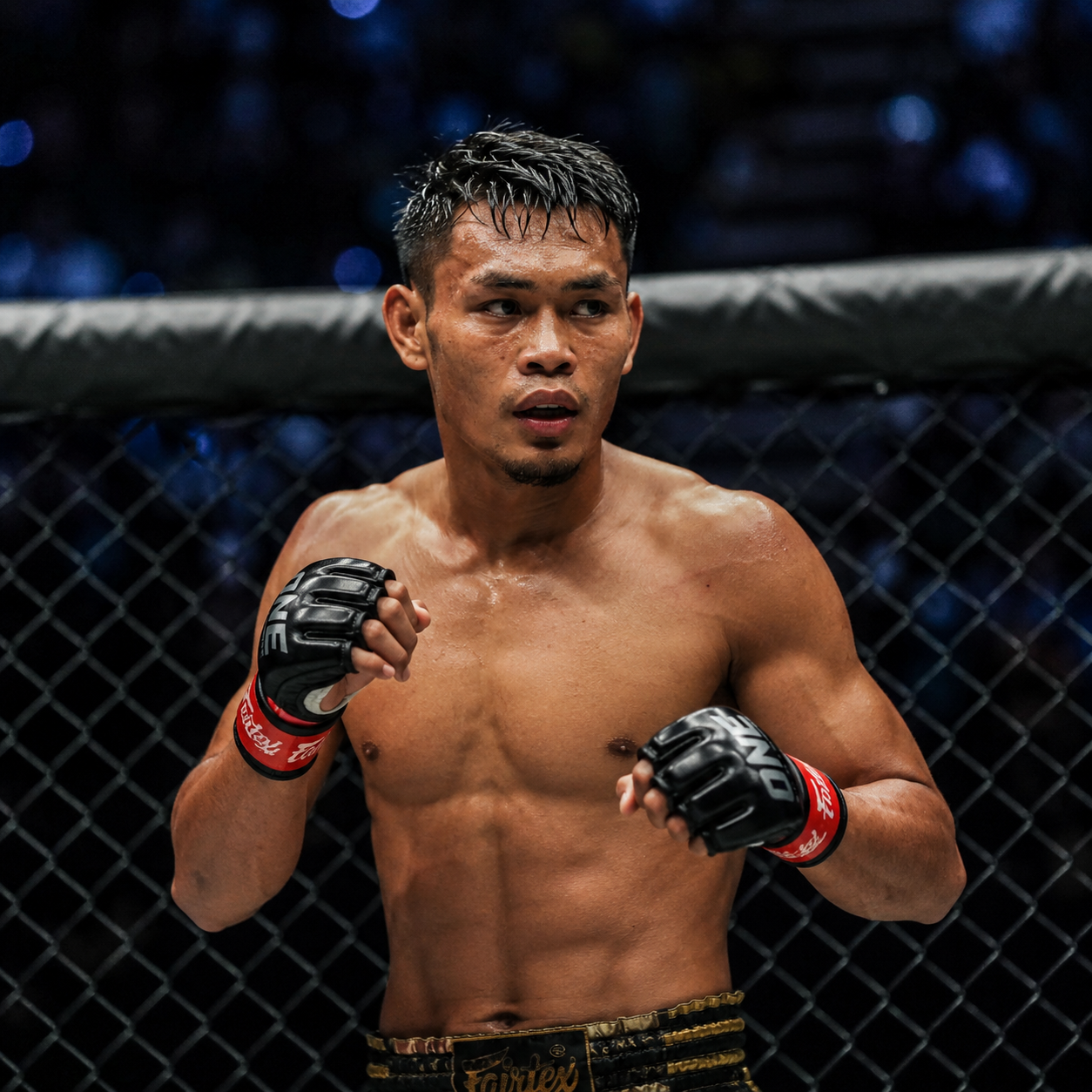
I first saw Agilan Thani fight at a ONE Championship event in Kuala Lumpur and remember thinking: here is someone who is not performing for the cameras. He was in the cage to win a fight. Not to look like a winner. Not to generate a highlight clip. To actually win.
That distinction matters more than it sounds. Malaysian MMA has produced fighters of real quality, but it has also produced a certain category of local hero — talented enough to build a following, rarely tested hard enough to know where the ceiling actually is. Agilan was different. He went looking for the ceiling.
A Career Defined by Ambition
Born in Klang, Selangor on August 18, 1995, Agilan built his record steadily through ONE Championship’s welterweight division. His nickname, “The Alligator,” was not just marketing. He had a wrestler’s patience — willing to wait, to absorb, to position — before moving with sudden violence. At his best, watching him was like watching a problem being solved methodically.
The defining moment of his ONE career came in 2017 when he challenged Ben Askren for the ONE Welterweight World Championship. Askren, one of the most decorated amateur wrestlers in American history, was virtually unbeatable on the ground in that era. Agilan, still only 21 years old, walked into that cage at Singapore Indoor Stadium knowing the style matchup was difficult. He fought it anyway.
He lost. But he competed. He threw combinations that troubled Askren. He showed that a fighter from Klang, trained in Malaysia, could share a cage with a champion of that calibre and belong there. That matters in ways that do not show up in a record.
What ONE Championship Gave Malaysian MMA
The relationship between ONE Championship and Malaysian MMA is worth examining. The Singapore-based promotion gave Malaysian fighters a credible platform to compete regionally while also providing development pathways through events like ONE Friday Fights in Bangkok, which Malaysian fighters continue to use to sharpen their craft.
For Agilan specifically, ONE offered something the domestic circuit could not: opponents who would expose every weakness. According to ONE Championship’s official fighter records, he competed across multiple weight class contexts and accumulated experience that defined him as one of the most credible Malaysian combatants of his generation.
The Body Pays
I have been close enough to the sport to know that a career like Agilan’s extracts a physical cost that is rarely discussed until it is too late to discuss. Weight management in Malaysia’s climate — training hard in a country where the baseline temperature never really drops — is a grind that accumulates over years.
When I spoke to trainers who have worked with Malaysian welterweights, the consistent theme was the toll of maintaining fight camp across a whole career. The mental sharpness required for world-class grappling, the physical preparation cycle, the travel to compete internationally — these compound over time in ways that do not appear in a highlight package.
That physical toll is part of the story of any career. The sports science community in Malaysia is only beginning to build the infrastructure to support fighters through it, as covered in the broader conversation about what lockdown revealed about Malaysian athletes’ bodies.
What the Alligator Left Behind
Agilan Thani did not retire with a belt. The record will show a fighter who competed at the highest level of Southeast Asian MMA for the better part of a decade, won more than he lost, and faced the best available opposition at his weight class.
What the record cannot show is what he gave the generation behind him. Every young Malaysian fighter who watched him get a world title shot understood something that is hard to teach: this is reachable. The platform is real. The only question is whether you are willing to pay what it costs to belong on it.
That is not nothing. In a sport still defining itself in this country, it is close to everything.