The Olympic cycle between Tokyo 2021 and Paris 2024 was the first in which Malaysia’s National Sports Institute had a genuinely structured sports science delivery programme attached to Paris preparation from the start. That is not a criticism of previous cycles — the infrastructure simply was not in place at the scale required before. But it is worth being clear that Paris 2024 was qualitatively different in how Malaysian athletes were prepared, and understanding why matters for what comes next.
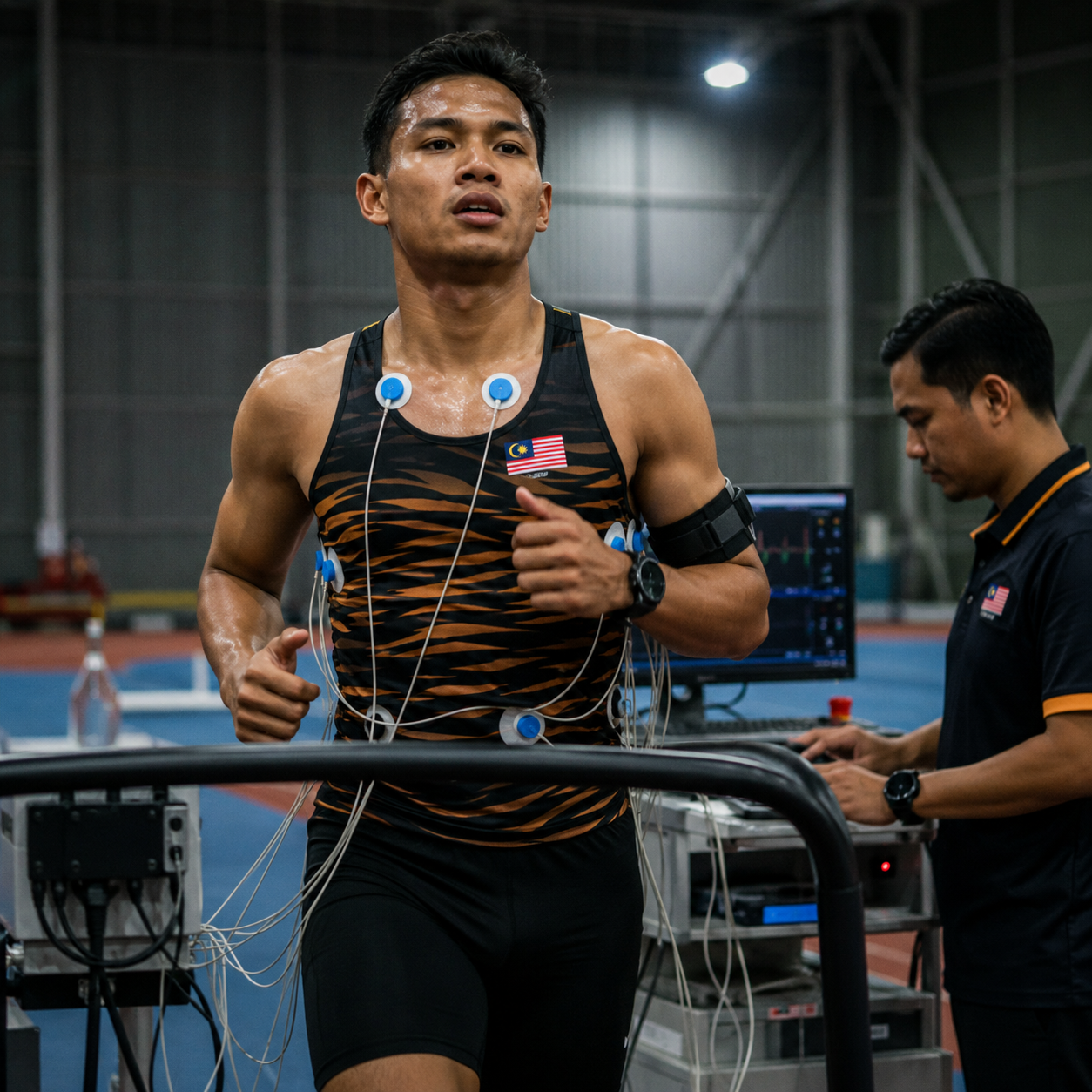
I have followed the Institut Sukan Negara’s work for over a decade, and the difference in 2024 was visible not in dramatic announcements but in the quieter indicators: the number of physiologists embedded with individual sport federations, the consistency of monitoring across the full preparation period, the integration of recovery science into camp schedules rather than its treatment as an optional add-on.
The Heat Acclimatisation Programme
Paris in late July and August is hot by European standards but significantly cooler than what Malaysian athletes train in daily. The challenge for Malaysian Olympic preparation is usually the reverse — managing heat as a performance variable when the host environment is one that disadvantages adaptation. In 2024, the relevant issue was ensuring that athletes who would perform in relative heat could do so at the intensity required.
The ISN sports science team worked with individual coaches to structure acclimatisation blocks that maintained heat exposure during preparation without compromising taper quality. According to reporting by Bernama on Malaysia’s Paris 2024 preparations, the Olympic Council of Malaysia coordinated with the national federations on a preparation timeline that integrated sports science support rather than leaving it to individual federation choice.
This was not perfect. Resource constraints meant that not every athlete had the same level of access to sports science support. The individual sport federations vary enormously in their capacity to integrate sports science, and the gap between the well-resourced federations — badminton, athletics — and the smaller sports remained significant.
Aaron Chia and the Bronze Template
The Tokyo 2021 Aaron Chia/Soh Wooi Yik bronze medal established a reference point for what systematic sports science preparation looks like when it works. The pairs’ preparation for Tokyo was one of the most carefully structured in Malaysian Olympic history — periodisation, physical monitoring, load management — and the medal validated that investment.
Paris 2024 built on that template, extending it more broadly across the badminton programme and attempting to apply its principles to other medal-potential sports. The application was not uniform, but the direction was right.
The Mental Health Dimension
One area where Paris 2024 represented genuine progress was psychological preparation. The mental health conversation in Malaysian sport had been catalysed by the pandemic period, and by 2024 the ISN had sports psychologists embedded in Olympic preparation in a way that would have been unusual four years earlier.
Athletes who had competed through the COVID period — the disrupted seasons, the empty venues, the specific stresses of bubble competition — carried psychological loads that physical preparation alone could not address. The Paris cycle was the first in which Malaysian sports administration took that explicitly seriously at the institutional level.
What the Results Mean
Malaysia’s Paris 2024 medal tally will be analysed and debated in the context of expectations. What is less visible in the final medal count is the quality of preparation infrastructure that underpinned it — infrastructure that, for the first time, gave Malaysian athletes across multiple sports a genuinely professional sports science environment for the full Olympic cycle.
That infrastructure does not guarantee medals. It creates the conditions in which talented athletes can perform closer to their potential. The gap between those two things is where Olympic success actually lives.
Paris 2024 was not the endpoint. It was evidence of a direction — and the question for the 2027 SEA Games and beyond is whether the investment sustains.