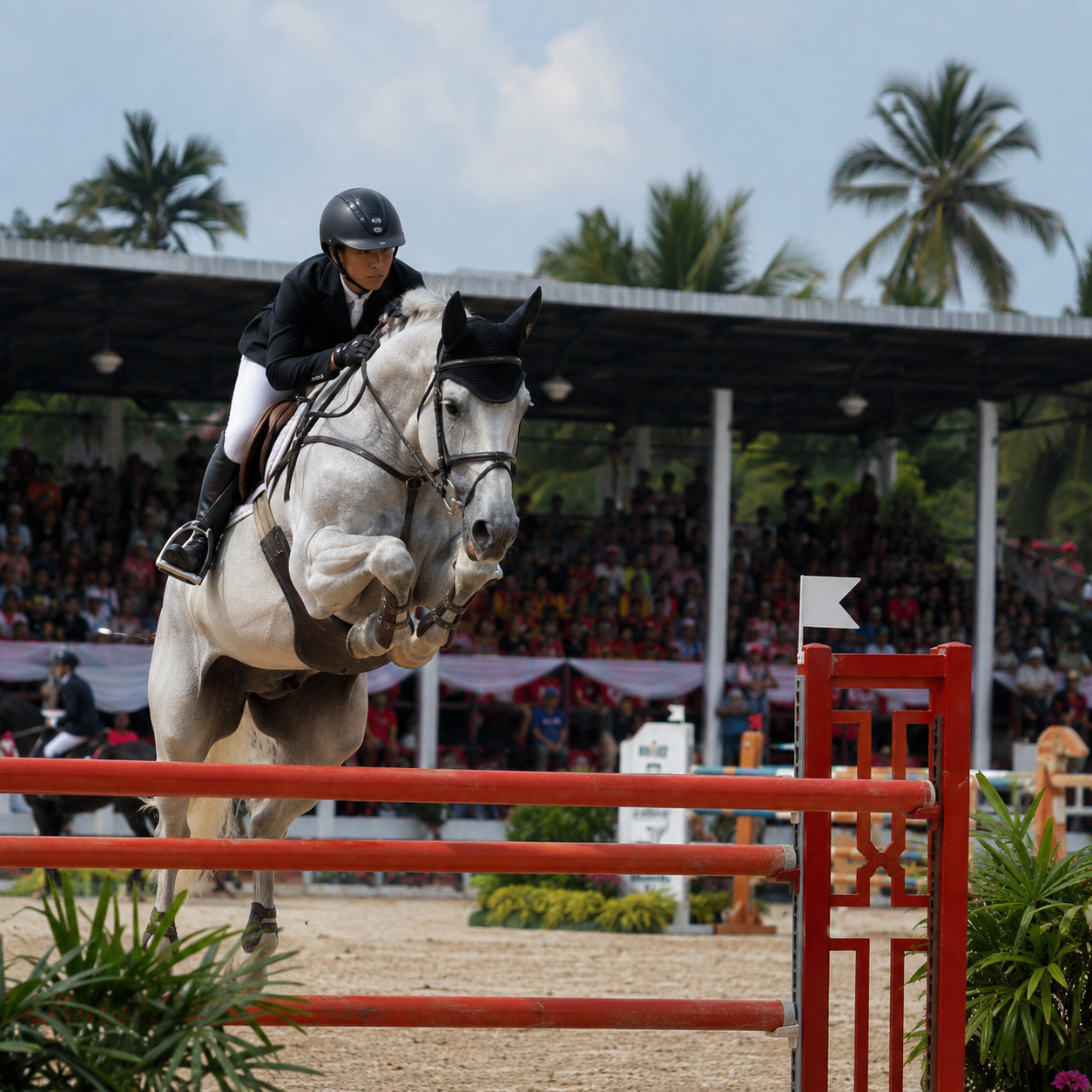
The SEA Games equestrian venue in Phnom Penh was not where most Malaysian sports journalists were directing their attention in May 2023. The aquatics, athletics, and combat sports were filling column inches. The equestrian events ran in a quieter corner of the Games, watched by a smaller crowd, covered by fewer reporters.
I went specifically for the equestrian programme. Not because the medal expectations were high — they were not — but because the equestrian discipline in Malaysia occupies a unique and underexamined position in the country’s sporting ecology, one that the commercial racing industry and the recreational riding community share in ways that are not always visible from the outside.
Malaysia’s Equestrian Landscape
Malaysian equestrian sport sits at the intersection of the thoroughbred racing industry — centred at Selangor Turf Club and the now-dissolved Penang Turf Club — and a separate sport horse and show jumping community that is smaller, less commercially visible, and less covered by mainstream Malaysian sports media.
The riders who represent Malaysia at SEA Games equestrian events come largely from this second community. They train at private facilities, many of which are not directly connected to the racing clubs, and compete in an international discipline calendar that rarely intersects with the domestic racing schedule.
According to the official 32nd SEA Games results via the Olympic Council of Asia, Malaysia competed in equestrian disciplines including show jumping. The results were creditable given the resources available, but a medal at SEA Games level requires a depth of development infrastructure that Malaysian sport horse breeding and training has not yet consistently achieved.
The Preparation Challenges
The logistical complexity of competing in equestrian events at an international multi-sport games is considerable. Horses must travel with health certification, veterinary oversight, and appropriate handling — a logistical overhead that does not apply to most sports. The biosecurity requirements for cross-border horse movement in Southeast Asia add another layer.
Malaysian equestrian competitors navigate these requirements as part of the cost of participation. For a discipline with limited central funding — the KBS sports budget allocation covers a wide range of sports, and equestrian’s relatively small competitive community means its share is proportionally modest — the financial burden of international competition falls heavily on athletes, their families, and private sponsors.
What Phnom Penh Showed
Malaysia’s equestrian team in Cambodia was there, competitive, and representative of a community that takes its sport seriously without the institutional backing that its SEA Games neighbours can often draw on. The Philippines and Thailand, in particular, have equestrian programmes with deeper private sector support and more consistent access to European-level competition and coaching.
The gap is visible in the results. It is less visible in the quality of individual Malaysian riders, who are genuinely accomplished athletes competing with the resources available to them.
The Industry Question
The trajectory of Malaysian horse racing — Penang’s dissolution, the questions around Selangor’s long-term viability — intersects with equestrian sport in ways that are not always discussed. The racing industry’s infrastructure: breeding expertise, veterinary services, horse husbandry knowledge — supports the broader equestrian community in Malaysia, even if the two sectors operate separately.
If Malaysian horse racing continues to contract, the supporting ecosystem that makes equestrian sport development possible also contracts. Phnom Penh 2023 was a performance delivered by athletes who rely, at some distance, on an industry that is under structural pressure.
That context belongs in the equestrian story even when it does not appear in the results table.